"Banned Books Week is an annual event celebrating the freedom to read. Banned Books Week was launched in 1982 in response to a sudden surge in the number of challenges to books in schools, bookstores and libraries. This year, it takes place October 5-11. It highlights the value of free and open access to information. Banned Books Week brings together the entire book community — librarians, booksellers, publishers, journalists, teachers, and readers of all types — in shared support of the freedom to seek and to express ideas, even those some consider unorthodox or unpopular." -bannedbooksweek.org
Wilmette Public Library protects your freedom to read by entrusting our collections and programs to qualified librarians, all of whom have master’s degrees in library and information sciences. In addition to their academic foundation, Wilmette librarians are constantly learning through professional development and topical coursework. Wilmette Public Library also has a comprehensive collection development policy, which provides a framework for inclusive resources and programs. The library provides programming throughout the year to explore the power of reading and the importance of the freedom to read as a community.
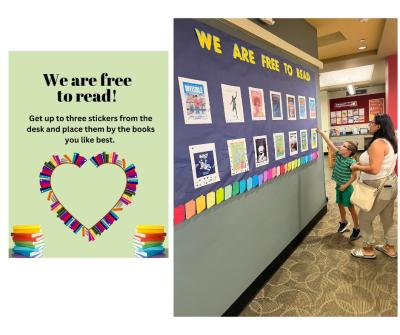
But how can you talk to your child about lofty ideas like freedom to read? Look to libraries to support you to have these big conversations. Visit the Youth Services department to interact with our “We are Free to Read” bulletin board. Put a heart next to the book(s) that you like the best or are interested in reading next. Use this prompt to talk to your child about their reading preferences, interests, and the stories they seek. Supporting self-selection promotes reading engagement and motivation, so helping children develop their personal taste is essential to lifelong reading.
Inspired by Brooklyn Public Library’s Freedom to Read Toolkit for Children and Families, here are some activities and conversation starters that can help your child understand their rights, celebrate the power of stories, and love of books.
- What kinds of stories do you like?
- Did you know you can choose what books you want to read in the library? How do you find the books you want?
- What can you do if you don’t like the book you’re reading?
- Draw a picture of your favorite book or character. What makes them important to you?
- What is your favorite thing about the library?
- What is your favorite book? What makes it special to you?
- Draw a picture of how you would feel if someone took away your favorite book. What can you do to make sure you can read your favorite book?
- What does freedom to read mean to you?
- What questions do you have about banned or challenged books?
As Kwame Alexander says, books can help us do the work. Check out these picture books from the library to learn more about book access and the freedom to read.
The Day the Books Disappeared by Joanna Ho and Caroline Kusin Pritchard, illustrated by Dan Santat
Arnold didn't mean for the books to disappear-not exactly. It all started because he liked his book about airplanes best and wanted everyone else to read it, too. He couldn't understand why anybody would want to read about tomatoes or ostriches or submarines. And suddenly. . . POOF! The books are gone. It's up to Arnold to figure out how it all happened--and what it will take to bring them back.
A Kids Book about Banned Books by the National Coalition Against Censorship
Every day across the country, books are challenged for telling stories, centering characters, and tackling topics that feel uncomfortable for some people. This book was made to help kids aged 5-9 understand why it’s worthwhile to challenge book banning. It explains what book banning is and helps start a conversation about how reading and having access to new information and ideas helps us stop, think, and grow!
This Book is Not For You by Shannon Hale, illustrated by Tracy Subisak
When the bookmobile librarian refuses to lend Stanley the story he wants, he learns the importance of advocating for the book of his choosing, and in doing so teaches the librarian the virtue in allowing everyone to select the stories they enjoy.
The Great Banned-Books Bake Sale by Aya Khalil, illustrated by Anait Semirdzhyan
Kanzi has come to feel welcome in her American school--that is, until an entire shelf of books about immigrant kids and kids of color suddenly disappears from the school library. Upon learning that the books with kids who look like her have been banned by her school district, Kanzi descends into fear and helplessness. But her classmates support her, and together--with their teacher's help--they hatch a plan to hold a bake sale and use the proceeds to buy diverse books to donate to libraries.
Roar for Reading by Beth Ferry
When Julius, a young lion, sees library books removed from the library, realizes the power of his voice and uses his roar to advocate for the value of all books.
Part memoir, part ode to reading, books, and libraries, Dreamers is a celebration of making your home with the things you always carry: your resilience, your dreams, your hopes and history. It's the story of finding your way in a new place, of navigating an unfamiliar world and finding the best parts of it. In dark times, it's a promise that you can make better tomorrows.
If you're looking for adult and teen book recommendations about book banning & the freedom to read, check out this blog post. If you're interested in more ways to support the freedom to read, check out this post.
And if you're curious about the library workers across the country fighting for democracy and our First Amendment Rights, check out The Librarians documentary, which will be in U.S. theaters starting October 3. You can see the trailer here.